Tag: Parenting’

Constructivism and your child

 - by Sarah Lipoff

Now that the tot is three, so many things have changed. She can talk her way through temper-tantrums explaining to us specifically why she is screaming and ranting, run that much faster away from us while we yell her name (desperately), and determine for herself if she’d like to nap or not (which is not so great for any down time for me). Sure, she’s also developing in amazing ways and exploring all the new things her brain and body can do, but it really seems so many of those things turn into a reason to have a toddler/parent show down.

And, during those moments, I try to take a few deep breaths and remind myself she’s a toddler and her behavior is typical. She’s also learning from the world around her, so setting a positive example is essential. It’s also pretty important to take a step back as the parent and give the child a chance to explore and learn from mistakes.

Through the concept of constructivism, a child is encouraged to learn through determining his own path of knowledge and individual process. Each child is different and special, just like their learning, and constructivism supports the idea that we construct our own understanding of the world we live in through generating rules and ideas based on individual experiences and trail and error. With the learning theory of constructivism, there are no flash cards or standardized tests. Instead, the child is supported to follow her instinct and create her own knowledge and strategies for understanding and learning.

Um, what the heck is constructivism? Don’t worry, it’s nothing to freak out about – and you might find learning about constructivism benefits you and your child. So, here are some facts…

The history of social constructivism leads us back to Lev Vygotsky and his social theories of learning. His studies found that a child often successfully accomplished new tasks while working in collaboration with an adult instead of on his own. This does not mean the adult is teaching the child how to solve problems, but through the act of the adult engaging with the child the learning experience improves and offers the child the ability to refine thinking and perform effectively. It is the idea of “can do” versus “cannot do,” and offering the child opportunities to change to the “can do” attitude with supportive, individual adult input.

By combining the idea of social and cognitive constructivism, the child is able to develop in positive ways. Social constructivism emphasizes the learning a child accomplishes through interaction with others and outside experiences. Cognitive constructivism is based on a child’s developmental stages and individual learning style. As stated before, each child is different and when her specific learning style is determined, her ability to learn is enhanced, especially when adults are able to fine-tune teaching to fit her specific learning.

Teaching with Constructivism

The educational system is not conducive to comfortably support constructivism in the mainstream classroom. But, there are small things educators, and parents, can do to support a child’s learning and development through constructivist theory. It is thought that most educators view learning as an objectivist theory, with the belief that learning exists outside of the bodies of learners residing in books and other educational documents. This leads to curriculum being based on teaching the child through textbooks instead of through experience. Through constructivism, the main way of learning is the senses, causing the brain to build a full understanding of the surrounding world. This leads us back to the understanding that each child is an individual creating separate unique responses and experiences.

With testing being the popular way to determine a child’s knowledge base, constructivism encourages the concept of experience and interaction. The process of learning through doing and engaging is the goal. Also, understanding each individual child’s prior-knowledge is key, used to build and grow adult interactions and teachings. This encourages greater bonds between adult and child and deeper educational experiences resulting in higher knowledge and self-esteem.

Ways to Integrate Constructivism

Introducing constructivist theory may seem like an unattainable goal for the classroom, but educators can make a difference through making simple changes and a bit of extra time. Parents can benefit from doing the same thing, creating a positive environment where the child is encouraged to explore and build his knowledge base through constructive ideals.

Take time to talk: It’s challenging in a bustling classroom to cover topics required by state standards of learning and maintain requirements of the school, but shortening lectures and book study and adding more interaction and discussion is one way to offer each student the opportunity to take part in learning. Including activities that encourage the student to apply their existing knowledge and real-world experiences promotes constructive learning. A healthy class debate is always a wonderful way to talk things out and hypothesis new ideas and problem solving.

At home, take time to talk through problems and encourage conversations at the dinner table, discussing new and exciting topics. And, don’t forget to ask lots of open-ended questions!

Doing is learning: Get out of the classroom and use those senses for learning! This goes for the home environment, too. As a population, we get caught up with the Internet and other social media as ways of entertainment and education. That big, heavy textbook has been replaced with surfing the interwebs. Turn to the great outdoors, along with real-life social interactions for learning and growth. Taking students into the real world to test their ideas and knowledge benefits constructive learning and understanding. Encourage a group discussion to finish the lesson after the out-of-classroom experience. And, parents can do the same by getting out of the house for a simple nature walk.

Ditch your expectations: Constructivism is not about test results and rote learning but about developing the child’s senses and understanding of the world around her. Find ways to encourage that learning through doing activities that are free of set limits and end results. Allowing a child to experiment with open-ended activities encourages creativity and self-esteem. If talking about weather systems, have students create a colorful weather collage. When discussing architecture, brainstorm as a group ways for building better covered bridges. Not only is the child developing her brain in amazing ways, she is pushing her senses to the limits learning more about his strengths and weaknesses and then making adjustments. Offering pre-tests allows for the teacher to gain understanding of student’s existing knowledge, aiding in creating educational lesson plans.

At home, direct open-ended questions without pressure on expectations. Use language focused on learning instead of results, such as grades, to instill confidence.

Introducing constructivist theory into the home or classroom is easier than one might think and offers fantastic benefits for both child and adult. So get out there and do some open-ended activities!

Date night (with a toddler)

 - by Sarah Lipoff

It’s been a long week. The tot came down with a pretty nasty sick ick and the husband was super busy. On top of all that, the hubs had something going on tonight (Friday), which meant I would be on my own all day and evening with the tot. Yeah, yeah. I know some of you are rolling your eyes. But, after being with her all week, and the husband only seeing her for about two hours total each day, I was a wreck.

Last night the husband had a crazy idea. What about a date night – with the tot in tow? She and I could take the ferry into the city, rendezvous with him at the Ferry Building to enjoy a quick dinner (and a sampling of other tasty goodies), and then the tot and I could return home on the ferry with the hubs following behind an hour or so after.

At first I thought he was joking.

Load up a sickie, drag her onto a ferry, and then try to have a tasty meal out in the city?!

Yup.

I did it.

We had an awesome time. Sure, she yelled the entire time on the ferry that she was going to see her dada. Sure, she wasn’t wonderfully behaved while we were eating – but we sat outside and it didn’t matter. And, yeah, I forgot to take a picture of our dinner (but we can partially blame that on the margherita I had with the meal).

But, here are a couple of other pics…

Happy Friday!

Fine art for kids: Layering with de Kooning

 - by Sarah Lipoff

The other day the tot was really into running her cars on everything. She raced them up and down the stairs, along the walls, and even through some paint. While I was hoping this fascination would wane, I actually was inspired by her artistic creation, which reminded me of an artist I know and love. Willem de Kooning was a Dutch born artist that lived in New York for the majority of his life creating colorful and vibrantly strong images. His technique of layering on colors sometimes with strong black lines that form a figure intrigue viewers into take a closer look.

Along with being full of color, de Kooning’s abstract creations are almost childlike in the way they are sloshed together. There are chaotic areas of color, jumbled together lines, and, somehow, an image all together in one place. I pulled the tot up to the laptop and shared with her a few of de Kooning’s creations to see what she had to say.

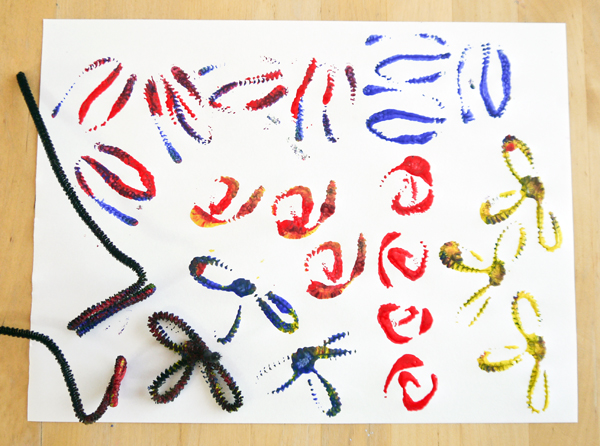
Because de Kooning’s artworks are a bit of a mish-mash of color and line, they are wonderful inspiration for some fun fine art creations. Invite your child to scrounge around for different types of art making tools (like feathers, big paintbrushes, tiny cars, plastic shapes), which can all be used to create expressive lines.

Along with being an exciting (and messy) activity, your child will learn more about color mixing and layering paint. Younger kids can simply mix paint along with experimenting with painting tools while older kids can try to create a form or shape hidden within the splotches of color.

Offer your child a sheet of paper and position all the painting items within close reach. If you’re not excited about mess, cover the area with newspaper and your child (and yourself) with a smock.

Go ahead and squeeze out a few drops of paint onto the paper and let your child have a fabulous time moving the different painting tools through the paint. Add more paint as you go, or swap out papers with fresh ones.

Once your child is finished, allow the artworks to dry for a couple of hours and then revisit. De Kooning often finished his artworks with the image of a person or additional areas of white to define the painting. Older children can use some black paint to bodily add more lines while younger tots can slather on a bit of white paint for extra impact. We dabbed on a bit of white paint and then ran the car over the painting a few final times with some dark brown paint.

Display your child’s finished de Kooning inspired creation in a special spot for others to enjoy!


Multiple intelligences and your child

 - by Sarah Lipoff

Now that the tot’s three, life is totally different. Really? No, it’s not. Things are moving and grooving in pretty much the same way other than she can say more words and sometimes figures out how to put them together into interesting sentences, such as, “I am so not good with being okay now,” or “You that now for me, right now, right now.”

Awesome.

I’m also spending a bit more time observing her play rather than directing it. She’s starting to be old enough to go off on her own and create her own emergency care center for her stuffed animals. While watching her (and also getting some of my work done) I’m finding she’s definitely leaning toward certain ways of learning, which is super exciting and a bit overwhelming.

How can I make sure she learns to her best ability?

Understanding that each individual child is different and special in her own way and also learns in her own way. Along with using her right and left-brain in combination, she has to make split-second decisions and tap into her emotional intelligence. But, along with all that, she has a special learning style that works best for her, and connecting with her multiple intelligences only boosts abilities to greater lengths.

Wait, what?

Yeah, that’s a bit of a chunk of information, but really, multiple intelligences aren’t as scary as you think…

Defining Multiple Intelligences

Multiple intelligences are the concept and understanding that individuals learn in different ways and are more apt to retain knowledge when information is presented in a certain way. Howard Gardner, a leading expert in the area of multiple intelligences, finds intelligence is the capacity to solve problems or to fashion products that are valued in one or more cultural settings. According to Gardner there are multiple intelligences that can be valued and encouraged, creating a stronger and smarter individual, or ignored, stunting potentially important growth.

As parents, or educators, we want our kids to be smarter and think to their greatest capacities. Understanding and appreciating the different ways that kids learn and taking the time to encourage their abilities is an essential step to promoting positive life skills and development. Our brains are born pre-wired to lean in one learning direction more than another. And then, through experiences, our intelligence is increased. Multiple intelligence theory taps into the child’s intrinsic levels of motivation through natural talents, which encourages learning and development in a comfortable way.

The Multiple-Intelligences

So, what are the nine multiple intelligences? Some are interrelated and overlap a bit, but each child possesses each of these nine intelligences in varying amounts, and some are more dominant than others. They are:

-Verbal-Linguistic – This includes the ability to use words and language. If your child has a knack for picking up languages, understands and uses language properly, he probably has leanings toward being a verbal-linguistic learner. Your child may prefer to read a book than finish his homework, but finding a balance is key. Offer rewards, such as a trip to the bookstore, once academic goals are met.

-Logical-Mathematical – For children this includes the capacity to understand and recognize numbers and abstract patterns. A kid that enjoys concentrating on challenging math or logic questions and engaging in exciting science experiments has logical-mathematical leanings. You might have the next great mathematical genius on your hands, so find ways to encourage those skills through playing games such as Sudoku or tangrams.

-Visual-Spatial – This is the ability to visualize objects and special dimensions and to create internal images and pictures. It is thought that left-brain dominant learners also learn concepts best through visual-spatial activities. Your budding artist may have a completely disorganized room, but actually know where each important item is located. Find ways to encourage his skills by challenging his logical right brain, such as using toothpicks to construct a building.

-Body-Kinesthetic – The ability to use the body in a controlled physical way. Just because your child has a hard time sitting still does not mean he is a challenging learner, but that he finds moving his body an essential part of his learning experience.  Find ways to tap into your child’s bodily abilities by encouraging participation in sports that promote problem solving and quick thinking.

-Musical-Rhythmic – Recognition of musical patterns, sounds, and rhythmic beats. Kids that are excited to pound away on the piano or want to spend hours practicing the viola are learning through all that music. In fact, playing an instrument may encourage your child’s understanding of math concepts.

-Interpersonal – The ability to create personal relationships and engage in person-to-person communication. Often, children that easily empathize with others or want to help and lead others are interpersonal learners. Your interpersonal child probably loves talking, sharing and working with others, so encourage her skills by offering a video camera to use for making a movie collaboratively with friends.

-Intrapersonal – When a child has the ability to understand self-reflection and inner being. Children that are able to identify and regulate their emotions and behaviors are intrapersonally intelligent. Although it may seem that your child is withdrawn or quiet, she has a busy inner-life. Offer your child lots and lots of journals to keep important notes – and remember to respect her privacy if she does not feel like sharing.

-Naturalistic – The ability to understand, recognize and categorize items in nature. Kids that are all about digging in the dirt and exploring nature around them many have a stronger naturalistic intelligence. So head outdoors with your budding naturalist and take a trip to your local zoo or museum. She will love the experience and feel nurtured to explore the nature around her.

-Existential – Understanding and striving to learn more about human existence and question and learn about life, death, and what happens after. Children that like to question and have deep inquisitive thoughts are existentially intelligent. It may be time to hit the library or explore researching together on the Internet when you grow tired of the questions. But, teaching your existential child research skills will only benefit her for years to come.

Encouraging Multiple Intelligences

Now that you have an idea what multiple intelligences may be stronger in your child than others, what to do?

-Understand that teaching children with blanket educational styles will not promote positive learning. Getting to know each child individually offers the ability for educators, and parents, to tap into children’s intelligences and adjust learning and teaching experiences.

-As a parent, take the time to educate yourself on the multiple-intelligences concept through reading and learning more about your own learning style and intelligences. When you as a parent understand a concept, ideas are easily implemented in the home.

-In the classroom, allow students to take part in their own assessment and grading to encourage their own intelligences and self-motivation. Along with taking part in assessment, students can be included in lesson planning and encouraged to offer their opinions and ideas for teaching and learning certain topics.

-Learn more about your child’s special area of expertise and encourage it. Like earlier stated, this means that if your child is showing signs of being the next Mozart, find ways to encourage her musical talents. Even if it is not an area you are fluent in, find ways to connect and further educate the child to help promote her way of learning.

Multiple-intelligences are just another great way to expand your child’s learning abilities and learn more about the wonders of the brain.


Fine art for kids: Parents.com

 - by Sarah Lipoff

I’m so excited to share that Parents.com picked up some of my fine art for kids activities! This was a really exciting project for me – and something that is really near and dear. With my background as an art teacher, creating, and getting creative, with kids is something really important to me and one of my big goals is to share that with others. Sure, sometimes my projects are a bit out there or might take you out of your comfort zone (like getting over your fear of glitter). But, hey, that’s what art is all about.

Even if you don’t think you are “crafty” you might find exploring art – and getting messy – with your kids is really fun. The first thing is to realize just making the effort to attempt creativity is the most exciting and important step. Embrace that fear of finger painting with a two-year-old, offer markers to your toddler, and wield that hot glue gun with no fear! Your kids won’t have a clue you’re shaking in your boots worrying your rug will be speckled with red paint or one of those markers might wander off…

They’ll just remember having a great time while making art with you.

Head on over to Parents.com to see what we put together – I know you’ll find something you and your kids will love creating!

Before getting started, here are a couple of tips for making arts and crafts time a happy time:

-Determine your boundaries: Pick an art corner in your house and make it clear that area is where mess can be made. Finding a spot near a sink is beneficial for those really crazy moments – or if things go a bit haywire. If your home is carpeted, invest in a cheapy carpet to put under your craft table to protect your floors. Heck, if you’ve got hardwood floors, it’s also a good idea! I’ve picked up several rugs from the local re-sale shop that have had wonderful lives as craft rugs. Kids go through different stages of art development, and some can be a bit messier than others.

-Prepare: Before starting a project, prep your materials just like you do before making a meal. Have your paper and art materials out and within reach so they can be offered, and removed, while creating with your child. I’ve got a toddler and find this is a serious part of doing fun and messy projects. As soon as she is finished with the paintbrushes, I whisk them away and offer her something else. This ensures those forgotten brushes don’t get rediscovered and end up being used to paint the drapes. Once the project is finished, have a spot for the artwork to dry or rest out of reach.

-Enjoy: Sure, I know you’re going to want to take a couple of pictures of all the fun you’re having while getting creative, but put the camera/phone down and give your child some undivided attention. Art is important and this is a great learning opportunity and chance to really chat with your child. Quiz her on colors she’s using, shapes she’s making, how her day went, her hopes and dreams….

We all get caught up with stuff around us (SOCIAL MEDIA), but quality time with your child is so important.

-Share: Once your art project is finished, proudly display it in your home. Not only is kid art cool art, it also shows your child how much you value her creation, boosting her self-confidence. Art is an essential part of emotional development and when your child feels she can safety and comfortably express herself through her art, she’ll feel better about herself, boosting her self-esteem, and aiding in her cognitive and creative development.

So what are you waiting for? Head on over to Parents.com with your child and pick a masterpiece to recreate!


Fun and simple memory games for kids

 - by Sarah Lipoff

My tot is all about wanting everything now and not remembering that a simple “thank you” goes a long way. Her brain is working a mile a minute and full of egocentric thought – and being polite isn’t important. Remembering to toss out a “please” or “thanks” is pretty rare, and I’m a bit tired of all that prompting.

Memory is a compilation of items that make up the ongoing experience of life. Although it’s a concept, and not a single tangible part of the brain, memory is an actual brain-wide process. Encouraging each individual memory helps the entire process work together, aiding kids in remembering the capitol of Peru and how to tie her shoes – or to simply say thank you.

There’s nothing wrong with having some fun while learning and honing memory skills. Sure, you can get out a few board games and get bored or mix things up with some inventive ways to use stuff around the house while spending some quality memory building time together.

What’s Missing? – Ages 4+

Take advantage of a child’s love of small items by creating a game utilizing a blanket and the power of her brain. Training the short-term memory to work longer than 20 to 30 seconds helps encourage a child’s brain to make strong memories, which can be accomplished through a fun memory activity.

-Have the child select five to seven small objects she would like to use for playing the game, such as miniature cars, plastic animals, or colored blocks.

-Take a moment to describe each item discussing its color, shape, and special characteristics. Explain to her that she will be playing a game with the items where one at a time, an object will go missing. Talking through an activity encourages the child’s left and right brain to work together, creating complete learning.

-Help position the objects in an arrangement on the floor or a table so they are close together. Once again, have her describe each object and its characteristics helping to form her memory of each item. Repeating aides in memory.

-Cover everything with a blanket and remove an item by hiding it in the palm of your hand and then placing it behind your back without allowing your child to see which item has been removed.

-Take away the blanket and ask your child what item is missing. If she has problems remembering, prompt her with descriptive words she used to describe the object, such as its color or shape.

-Continue removing items and playing until no items are left. Once all the objects have gone missing, ask if she can recall each item that was used to play the memory building game.

Rhyme it Up – ages 7+

Young adults are busy with schoolwork and hanging out with friends. Helping memory skills with a mnemonics memory activity gives an edge when it comes to getting homework done so there is more time to socialize – and will keep parents happy with the resulting good grades.

-Have your child select a collection of items or facts she would like to work on memorizing, such as social studies facts for an upcoming test.

-Using story telling as a memory booster is a fun and entertaining way to train the brain. To remember information, it needs to be committed to long-term memory with connections that make the facts easier to recall.

-Discuss with your child what mnemonics are and how they benefit memory skills. Mnemonics can be any type of rhyme, story, song, or chant to help remember items. For example, just about everyone knows, “in 1492, Columbus sailed the ocean blue.”

-Help your child organize the information she would like to use for creating a fun story mnemonic. Once she’s ready, she can write out the story using key words from her facts, making sure to connect each sentence so her story is easy to remember. Remember, the sillier the better!

-Now she can share the funny mnemonic story with others, strengthening her memory skills and testing others on their retention abilities.

-After sharing her story, she can test listeners by seeing how much of the silly mnemonic they can repeat back without help. Your child can aide listeners by giving them prompts as needed.

-See who can remember the most of the silly mnemonic out of your child’s friends and family and offer a prize to the memory game winner.

Total Recall – 11+

Tweens and teens have lots of pressures including excelling in school along with after school sports and activities, other responsibilities such as jobs, and socializing with friends. Help everyone keep on track with a memory boosting game that also offers the opportunity to spend some quality time together too.

-Select several images from magazines to use for the memory activity, such as pictures of people sitting in a restaurant, images of different types of landscapes, or advertisements.

-Everyone has a different type of learning, and using that to tap into memory is extremely beneficial. Your teenager can experiment with her learning style by playing a memory game using the magazine pictures and determining which way encourages the best memory retention.

-Using a timer, provide your teen with a magazine pictures and set the timer for 3 minutes. The goal is to see how many random things she can memorize about the picture and then recall later. Encourage your child to work silently, tapping into her concrete learning style.

-Once the time is up, she can pass over the picture to be quizzed. Ask her various questions such as how many people are in the picture, what color clothes individuals are wearing, animals in the image, and so on.

-Keep track of all her correct answers and the ones that she misses.

-Now she can do the process again but with a different picture. This time, she can describe the image out loud instigating her active learning. Does this help or hinder her memory retention?

-Compare and contrast her skills from previous picture and if she had better results while memorizing silently or while talking.

-Other ideas would be for her to act out the image, write out words for prompts, or create a rhyme for the picture to help remember information within the 3 minutes for each picture.

-See which way of learning provides the best results for the memory retention game and offer a reward for all her hard work – like heading out for some well-deserved ice cream.

Playing memory games are a fun way to train the brain and also boost retention skills. Keeping the memory strong ensures those special memories will be around for many years to come, along with all those important facts and dates.


On-the-fly art activities

 - by Sarah Lipoff

Taking a toddler on a plane is always a challenge. It doesn’t matter if it’s a 30-minute flight or 30 hours, your tot is bound to freak out at some point. So pack some extra goodies and do a few on-the-fly art activities everyone will enjoy! Yeah, that’s right, put away that iPad and enjoy some locked in flight fun and a bit of family time.

Really.

If your kiddo breaks down after 20-minutes of being creative, pull that iPad back out and cuddle up with a movie. But making on-the-fly art is always a great way to have a wonderful time with your tot – and maybe make something fun yourself! And these fun activities hardly take up any room in your carry-on.

(These art activities would also work wonderfully in the car…)

Beaded pipe-cleaner bracelet

In a small plastic bag or lidded container place some colorful beads along with a couple of pipe cleaners. Your child can secure one end by twisting on a bead and then threading the rest. To finish the bracelet, help your child twist and hold together the ends. Voila! Cute on-the-fly bracelet. Great for boys or girls!

String wrapped headband

Pick up a plain headband and gather a small ball of string. Sure, this project isn’t really for the boys, but that’s okay. Your kiddo can skip this activity for a different one… Now help your child tie one end of the string to the headband and then start wrapping and wrapping. She can tear off lengths of different colored string and tie each section off when she’s done until the headband is all strung up or use all one color.

Night-time sticker paint

Cut a few pieces of paper until they are the size of a zip-top bag and pop them in along with a few sheets of basic star stickers, a blue and green marker, and a paintbrush. Once your happy stewardess has made a walk through, ask for a small glass of water and your child can get marker painting! Start by placing a few stars all over one of the papers and then offer your child the markers to make lots and lots of swirling lines. Then she can use that bit of water and the brush to water paint all over the paper, creating her own night-time star sticker creation.

Binoculars

Pop a couple of toilet paper tubes in with all the rest of your on-the-fly art activities and bring them out to use all the leftover bits of materials for creating a special set of binoculars for the final leg of the plane ride. Your child can stick a few star stickers all over those two tubes, use the markers to create colorful lines, add a bit of water to blend them together, and then string a string with any remaining beads to use for holding the binoculars together. Help finish things up by twisting the string around the two tubes in a figure eight several times and then tying together. The beaded string can be added as perfect on-the-fly binocular strap.

Happy flying!


Peer pressure and the brain

 - by Sarah Lipoff

Even my toddler is starting to succumb to peer pressure. Sure, she’s just two, but I see her following along with the big kids at the play ground and being coerced into trying the slide even though she’s not really ready for it yet. Luckily I can jump in and rescue her, but know, in just a blink of an eye, she’s going to be out there on her own dealing with peer pressure and need to prepare myself for helping her down that path.

Throughout life there are many times when outside influences change or influence decision-making. The young child has inner motivation to learn and explore, but as a child matures, finds outside sources to be a motivating force for development. Along with being influential in positive ways, there are moments when peer pressure can be overwhelming and lead a child down a challenging path. And peer pressure is a real thing – it is not only observable, but changes the way the brain behaves.

Observational Learning

As a young adult, observational learning plays a part in development through observing and then doing. A child sees another child playing a game in a certain way and having success, so the observing child tries the same behavior. Alburt Bandura was a leading researcher in this area. His famous bobo doll studies found that the young child is greatly influenced by observing other’s actions. When a child sees something that catches his attention, he retains the information, attempts to reproduce it, and then feels motivated to continue the behavior if it is met with success.

Observational learning and peer pressure are two different things – one being the observing of behaviors and then the child attempting to reproduce them based on a child’s own free will. The other, peer pressure, is the act of one child coercing another to follow suit. Often the behavior being pressured is questionable or taboo, such as smoking cigarettes or drinking alcohol.

As adults we can rehash our “firsts” and the times something new was explored or experienced. Often there were others tagging along for the ride – or egging the behavior on.

You know what I’m talking about…

Peer Pressure and the Brain

Recent studies find that peer pressure influences the way our brains behave, which leads to better understanding the impact of peer pressure and the developing child.

According to studies from Temple University, peer pressure has an effect on brain signals involved in risk and reward department, especially when a teen’s friends are around.  Compared to adults in the study, teenagers were much more likely to take risks they would not normally take on their own when with friends. Brain signals were more activated in the reward center of the brain, firing greatest during at risk behaviors.

Peer pressure can be difficult for young adults to deal with and learning ways to say “no” or avoid pressure-filled situations can become overwhelming. Resisting peer pressure is not just about saying “no,” but how the brain functions. Children that have stronger connections among regions in their frontal lobes, along with other areas of the brain, are better equipped to resist peer pressure. During adolescence, the frontal lobes of the brain develop rapidly, causing axioms in the region to have a coating of fatty myelin, which insulates them and causes the frontal lobes to more effectively communication with other brain regions. This helps the young adult to develop judgment and self-control needed to resist peer pressure.

Along with the frontal lobes contributing to the brain and peer pressure, other studies find that the prefrontal cortex plays a role in how teens respond to peer pressure. Just as with the previous study, children that were not exposed to peer pressure had greater connectivity within the brain as well as abilities to resist peer pressure.

Working Through Peer Pressure

The teenage years are exciting times. The young adult is often going through physical changes (um, yeah, puberty), adjusting to new friends and educational environments, and learning how to make decisions for themselves Adults can offer a helping and supportive hand, which may not always be happily accepted, to young adults when dealing with peer pressure by considering the following:

Separation: Understanding that this is a time for the child to separate and learn how to be his own individual is important. It is hard to let go and allow the child to make mistakes for himself, especially when you want to offer input or change plans and actions, but allowing the child to go down his own path is important. As an adult, offer a helping hand if things go awry and being there to offer support is beneficial.

And don’t toss out, “I told you so.”

Talk it Out: As an adult, take a firm stand on rules and regulations with your child. Although you cannot control whom your child selects as friends, you can take a stand on your control of your child. Setting specific goals, rules, and limits encourages respect and trust, which must be earned in response. Do not be afraid to start talking with your child early about dealing with peer pressure and educating about ways to resist peer pressure, which builds confidence in your child to say “no” at the right time without feeling guilt or loss of self-confidence.

Stay Involved: Keep family dinner as a priority, make time each week for a family meeting or game time, and plan family outings and vacations regularly. Spending quality time with kids models positive behavior and offers lots of opportunities for discussions about what is happening at school and with friends.

If at any time there are concerns a child is becoming involved in questionable behavior due to peer pressure, ask for help. Understand that involving other’s in helping a child cope with peer pressure, such as a family doctor, youth advisor, or other trusted friend, does not mean that the adult is not equipped to properly help the child, but that including others in assisting a child, that may be on the brink of heading down the wrong path, is beneficial.


Fine art for kids – Stamping with Marimekko

 - by Sarah Lipoff

The wonderful thing about art is that it encompasses lots and lots of stuff. Sure, most think of fine art as the stuff you see hanging in museums, but art is all around us and totally influences everything from what we watch on TV to the clothes we wear.

While creating our fall leaf wreath the other day, it reminded me of this wonderful patterned fabric I’d come across from Marimekko. It’s colorful, crisp, and absolutely vibrant. Armi Ratia started the ball rolling in 1951 when she designed her fist dress – and it was a hit. Through the years, Marimekko has become one of the most respected textile companies dressing famously fabulous ladies for decades. Some might say Jacki-O put them on the map when she was photographed wearing a pink Marimekko dress during the Kennedy vs. Nixon election.

A woman’s company made for making women awesome, Marimekko is all about mod-design and embracing that inner flower power. The patterns are still living strong today and new designers keep things moving and grooving. So, while cleaning up our fall leaf wreath mess, I got an idea for a fabulous Marimekko inspired project.

Start by inviting your little designer to take a look at Marimekko’s designs focusing on the patterns and shapes. This project is great for kids of all ages – girls and boys. The Unikko fabric in orange and yellow is perfect inspiration for a fall flower stamping creation!

Offer your child a pencil and a sheet of scrap paper. Encourage her to free-form draw a few organic flower shapes. Organic shapes are free of sharp edges or jutting corners or lines. She can even shake out her hands and arms to get her in the organic shape making mood.

Once she’s created an organic flowery shape she’s satisfied with, your child can cut it out with a scissors and then trace it onto a piece of super-washed and dried styrofoam (yeah, that’s right, we used a meat tray for our stamps). Or a nice section of cardboard works wonderfully.

To create an easy-to-use stamp, offer a helping hand by taping a die or a small block to the back of the styrofoam, or cardboard, cutout.

For a fall inspired Marimekko stamped creation, your child can squeeze a bit of orange paint on a paper plate and start stamping away. She can create a pattern or random arrangement of her mod flowers. We experimented with color theory by mixing red and yellow paint together.

Once the flowers have dried, she can add details to the flowers using small circular items for stamping, such as bottle caps or round blocks. She can also use brushes and some black paint for adding stems. Your child can explore her ability for creating unique designs by working until she’s satisfied with the end result!

The finished Marimekko inspired stamp art can be displayed on the family fridge, or offer your child several sheets to keep on stamping and use her creations as placemats for Thanksgiving dinner!


Sunday spectacular: Oxbow Market, Napa

 - by Sarah Lipoff

This week has been pretty crazy at our house. I had a couple of free days and decided to completely dedicate myself to the tot and potty training. It was time – but she needed me to put the darn computer down and pay attention.

So I did.

And we had a great time going to the potty every 20-minutes.

Really.

I also decided I wasn’t going to change our daily routine to work around the whole potty training thing. I just assumed my tot would go on the potty no matter where we were.

I had no idea that public restrooms are the total scariest things ever to a toddler. All those people, so much noise, and that whole being-confined-in-a-small-space thing.

Today the husband was going a bit bonkers hanging around the house and suggested a drive. I gave him a look, and he reminded me we made it out and about for a couple of hours the other day without any accidents…..

We loaded up and headed out to the Oxbow Market in Napa. It’s kind of a mini-mall for foodies. There’s a spice shop, specialty coffee, bakeries, a fish monger, oysters, cheese, ice cream, chocolates, and RESTAURANTS.

While strolling around and waiting for our tasty lunch, we headed to the bathroom – with no success.

I figured a little bribery was in order.

To the delight of any other’s ears in that public restroom I yelled out…

“If you want one of those super yummy cupcakes I better hear some potty right now!”

Let’s just say someone got that cupcake.

© Sarah Lipoff 2011

© Sarah Lipoff 2011

© Sarah Lipoff 2011

© Sarah Lipoff 2011

© Sarah Lipoff 2011

© Sarah Lipoff 2011

© Sarah Lipoff 2011