Tag: child development’
Multiple intelligences and your child
- by Sarah Lipoff
Now that the tot’s three, life is totally different. Really? No, it’s not. Things are moving and grooving in pretty much the same way other than she can say more words and sometimes figures out how to put them together into interesting sentences, such as, “I am so not good with being okay now,” or “You that now for me, right now, right now.”
Awesome.
I’m also spending a bit more time observing her play rather than directing it. She’s starting to be old enough to go off on her own and create her own emergency care center for her stuffed animals. While watching her (and also getting some of my work done) I’m finding she’s definitely leaning toward certain ways of learning, which is super exciting and a bit overwhelming.
How can I make sure she learns to her best ability?
Understanding that each individual child is different and special in her own way and also learns in her own way. Along with using her right and left-brain in combination, she has to make split-second decisions and tap into her emotional intelligence. But, along with all that, she has a special learning style that works best for her, and connecting with her multiple intelligences only boosts abilities to greater lengths.
Wait, what?
Yeah, that’s a bit of a chunk of information, but really, multiple intelligences aren’t as scary as you think…
Defining Multiple Intelligences
Multiple intelligences are the concept and understanding that individuals learn in different ways and are more apt to retain knowledge when information is presented in a certain way. Howard Gardner, a leading expert in the area of multiple intelligences, finds intelligence is the capacity to solve problems or to fashion products that are valued in one or more cultural settings. According to Gardner there are multiple intelligences that can be valued and encouraged, creating a stronger and smarter individual, or ignored, stunting potentially important growth.
As parents, or educators, we want our kids to be smarter and think to their greatest capacities. Understanding and appreciating the different ways that kids learn and taking the time to encourage their abilities is an essential step to promoting positive life skills and development. Our brains are born pre-wired to lean in one learning direction more than another. And then, through experiences, our intelligence is increased. Multiple intelligence theory taps into the child’s intrinsic levels of motivation through natural talents, which encourages learning and development in a comfortable way.
The Multiple-Intelligences
So, what are the nine multiple intelligences? Some are interrelated and overlap a bit, but each child possesses each of these nine intelligences in varying amounts, and some are more dominant than others. They are:
-Verbal-Linguistic – This includes the ability to use words and language. If your child has a knack for picking up languages, understands and uses language properly, he probably has leanings toward being a verbal-linguistic learner. Your child may prefer to read a book than finish his homework, but finding a balance is key. Offer rewards, such as a trip to the bookstore, once academic goals are met.
-Logical-Mathematical – For children this includes the capacity to understand and recognize numbers and abstract patterns. A kid that enjoys concentrating on challenging math or logic questions and engaging in exciting science experiments has logical-mathematical leanings. You might have the next great mathematical genius on your hands, so find ways to encourage those skills through playing games such as Sudoku or tangrams.
-Visual-Spatial – This is the ability to visualize objects and special dimensions and to create internal images and pictures. It is thought that left-brain dominant learners also learn concepts best through visual-spatial activities. Your budding artist may have a completely disorganized room, but actually know where each important item is located. Find ways to encourage his skills by challenging his logical right brain, such as using toothpicks to construct a building.
-Body-Kinesthetic – The ability to use the body in a controlled physical way. Just because your child has a hard time sitting still does not mean he is a challenging learner, but that he finds moving his body an essential part of his learning experience. Find ways to tap into your child’s bodily abilities by encouraging participation in sports that promote problem solving and quick thinking.
-Musical-Rhythmic – Recognition of musical patterns, sounds, and rhythmic beats. Kids that are excited to pound away on the piano or want to spend hours practicing the viola are learning through all that music. In fact, playing an instrument may encourage your child’s understanding of math concepts.
-Interpersonal – The ability to create personal relationships and engage in person-to-person communication. Often, children that easily empathize with others or want to help and lead others are interpersonal learners. Your interpersonal child probably loves talking, sharing and working with others, so encourage her skills by offering a video camera to use for making a movie collaboratively with friends.
-Intrapersonal – When a child has the ability to understand self-reflection and inner being. Children that are able to identify and regulate their emotions and behaviors are intrapersonally intelligent. Although it may seem that your child is withdrawn or quiet, she has a busy inner-life. Offer your child lots and lots of journals to keep important notes – and remember to respect her privacy if she does not feel like sharing.
-Naturalistic – The ability to understand, recognize and categorize items in nature. Kids that are all about digging in the dirt and exploring nature around them many have a stronger naturalistic intelligence. So head outdoors with your budding naturalist and take a trip to your local zoo or museum. She will love the experience and feel nurtured to explore the nature around her.
-Existential – Understanding and striving to learn more about human existence and question and learn about life, death, and what happens after. Children that like to question and have deep inquisitive thoughts are existentially intelligent. It may be time to hit the library or explore researching together on the Internet when you grow tired of the questions. But, teaching your existential child research skills will only benefit her for years to come.
Encouraging Multiple Intelligences
Now that you have an idea what multiple intelligences may be stronger in your child than others, what to do?
-Understand that teaching children with blanket educational styles will not promote positive learning. Getting to know each child individually offers the ability for educators, and parents, to tap into children’s intelligences and adjust learning and teaching experiences.
-As a parent, take the time to educate yourself on the multiple-intelligences concept through reading and learning more about your own learning style and intelligences. When you as a parent understand a concept, ideas are easily implemented in the home.
-In the classroom, allow students to take part in their own assessment and grading to encourage their own intelligences and self-motivation. Along with taking part in assessment, students can be included in lesson planning and encouraged to offer their opinions and ideas for teaching and learning certain topics.
-Learn more about your child’s special area of expertise and encourage it. Like earlier stated, this means that if your child is showing signs of being the next Mozart, find ways to encourage her musical talents. Even if it is not an area you are fluent in, find ways to connect and further educate the child to help promote her way of learning.
Multiple-intelligences are just another great way to expand your child’s learning abilities and learn more about the wonders of the brain.
Homemade self-drying play dough
- by Sarah Lipoff
Since my parents have left I’ve had to get back to doing all that stuff I used to, like putting away the dishes, doing my own laundry, and playing with the tot. Needless to say this week kicked me hard in the tushi and I was in need of some serious help keeping things together – including my daughter from having a complete and utter boredom breakdown.
In the gift-opening panacea that was the holidays blended with the tot’s birthday, we got several small containers of play dough, which were played with for hours and hours while Gamma was here. The thing is, all that play dough blended together into an unappealing looking green blob – and left this chemical-ick smell on our hands.
Blech.
So the other day we tossed together some of our own handmade play dough – with a spin. Instead of going through all that work to heat and stir and cook, I simplified things by adding hot liquid to the flour and salt. And, to combat that wallpaper paste smell of flour and water, we added some fresh grated lemon zest and juice to the hot water.
What’s really fun about this play dough is you can add food coloring and some scented oil to make things different. We tossed in a few drops of lemon food coloring to add to the already yellow tinged dough. Once your child gets tired of squishing with the play dough, the finished creations can be left to air dry, or baked in the oven on low heat for about an hour, creating a nice, hard little sculpture they can paint or put on display for everyone to admire.
We used a few cookie cutter to make fun shapes, which we then put together into a mobile….
Ingredients
4 c flour
1 c salt
2 tbsp vegetable oil
1 1/2 to 2 c hot water
Zest of one lemon plus its juice (optional)
Food coloring (optional)
Scented oil (optional)
Directions
Measure and add the flour and salt to a big mixing bowl.
Bring the water to a boil along with the zest and juice from the lemon.
Add the hot water to the flour and salt mixture, along with the vegetable oil (along with the food coloring and scented oil), and give a good stir. If things feel too stiff, add a bit more water. Or, if things are too watery, add a bit more flour.
Dump the dough onto a work surface and knead until everything is nice and smooth without being sticky.
It’s that simple!
*To bake finished items, place in a 250 F oven for an hour.
Fine art for kids: Parents.com
- by Sarah Lipoff
I’m so excited to share that Parents.com picked up some of my fine art for kids activities! This was a really exciting project for me – and something that is really near and dear. With my background as an art teacher, creating, and getting creative, with kids is something really important to me and one of my big goals is to share that with others. Sure, sometimes my projects are a bit out there or might take you out of your comfort zone (like getting over your fear of glitter). But, hey, that’s what art is all about.
Even if you don’t think you are “crafty” you might find exploring art – and getting messy – with your kids is really fun. The first thing is to realize just making the effort to attempt creativity is the most exciting and important step. Embrace that fear of finger painting with a two-year-old, offer markers to your toddler, and wield that hot glue gun with no fear! Your kids won’t have a clue you’re shaking in your boots worrying your rug will be speckled with red paint or one of those markers might wander off…
They’ll just remember having a great time while making art with you.
Head on over to Parents.com to see what we put together – I know you’ll find something you and your kids will love creating!
Before getting started, here are a couple of tips for making arts and crafts time a happy time:
-Determine your boundaries: Pick an art corner in your house and make it clear that area is where mess can be made. Finding a spot near a sink is beneficial for those really crazy moments – or if things go a bit haywire. If your home is carpeted, invest in a cheapy carpet to put under your craft table to protect your floors. Heck, if you’ve got hardwood floors, it’s also a good idea! I’ve picked up several rugs from the local re-sale shop that have had wonderful lives as craft rugs. Kids go through different stages of art development, and some can be a bit messier than others.
-Prepare: Before starting a project, prep your materials just like you do before making a meal. Have your paper and art materials out and within reach so they can be offered, and removed, while creating with your child. I’ve got a toddler and find this is a serious part of doing fun and messy projects. As soon as she is finished with the paintbrushes, I whisk them away and offer her something else. This ensures those forgotten brushes don’t get rediscovered and end up being used to paint the drapes. Once the project is finished, have a spot for the artwork to dry or rest out of reach.
-Enjoy: Sure, I know you’re going to want to take a couple of pictures of all the fun you’re having while getting creative, but put the camera/phone down and give your child some undivided attention. Art is important and this is a great learning opportunity and chance to really chat with your child. Quiz her on colors she’s using, shapes she’s making, how her day went, her hopes and dreams….
We all get caught up with stuff around us (SOCIAL MEDIA), but quality time with your child is so important.
-Share: Once your art project is finished, proudly display it in your home. Not only is kid art cool art, it also shows your child how much you value her creation, boosting her self-confidence. Art is an essential part of emotional development and when your child feels she can safety and comfortably express herself through her art, she’ll feel better about herself, boosting her self-esteem, and aiding in her cognitive and creative development.
So what are you waiting for? Head on over to Parents.com with your child and pick a masterpiece to recreate!
Fun and simple memory games for kids
- by Sarah Lipoff
My tot is all about wanting everything now and not remembering that a simple “thank you” goes a long way. Her brain is working a mile a minute and full of egocentric thought – and being polite isn’t important. Remembering to toss out a “please” or “thanks” is pretty rare, and I’m a bit tired of all that prompting.
Memory is a compilation of items that make up the ongoing experience of life. Although it’s a concept, and not a single tangible part of the brain, memory is an actual brain-wide process. Encouraging each individual memory helps the entire process work together, aiding kids in remembering the capitol of Peru and how to tie her shoes – or to simply say thank you.
There’s nothing wrong with having some fun while learning and honing memory skills. Sure, you can get out a few board games and get bored or mix things up with some inventive ways to use stuff around the house while spending some quality memory building time together.
What’s Missing? – Ages 4+
Take advantage of a child’s love of small items by creating a game utilizing a blanket and the power of her brain. Training the short-term memory to work longer than 20 to 30 seconds helps encourage a child’s brain to make strong memories, which can be accomplished through a fun memory activity.
-Have the child select five to seven small objects she would like to use for playing the game, such as miniature cars, plastic animals, or colored blocks.
-Take a moment to describe each item discussing its color, shape, and special characteristics. Explain to her that she will be playing a game with the items where one at a time, an object will go missing. Talking through an activity encourages the child’s left and right brain to work together, creating complete learning.
-Help position the objects in an arrangement on the floor or a table so they are close together. Once again, have her describe each object and its characteristics helping to form her memory of each item. Repeating aides in memory.
-Cover everything with a blanket and remove an item by hiding it in the palm of your hand and then placing it behind your back without allowing your child to see which item has been removed.
-Take away the blanket and ask your child what item is missing. If she has problems remembering, prompt her with descriptive words she used to describe the object, such as its color or shape.
-Continue removing items and playing until no items are left. Once all the objects have gone missing, ask if she can recall each item that was used to play the memory building game.
Rhyme it Up – ages 7+
Young adults are busy with schoolwork and hanging out with friends. Helping memory skills with a mnemonics memory activity gives an edge when it comes to getting homework done so there is more time to socialize – and will keep parents happy with the resulting good grades.
-Have your child select a collection of items or facts she would like to work on memorizing, such as social studies facts for an upcoming test.
-Using story telling as a memory booster is a fun and entertaining way to train the brain. To remember information, it needs to be committed to long-term memory with connections that make the facts easier to recall.
-Discuss with your child what mnemonics are and how they benefit memory skills. Mnemonics can be any type of rhyme, story, song, or chant to help remember items. For example, just about everyone knows, “in 1492, Columbus sailed the ocean blue.”
-Help your child organize the information she would like to use for creating a fun story mnemonic. Once she’s ready, she can write out the story using key words from her facts, making sure to connect each sentence so her story is easy to remember. Remember, the sillier the better!
-Now she can share the funny mnemonic story with others, strengthening her memory skills and testing others on their retention abilities.
-After sharing her story, she can test listeners by seeing how much of the silly mnemonic they can repeat back without help. Your child can aide listeners by giving them prompts as needed.
-See who can remember the most of the silly mnemonic out of your child’s friends and family and offer a prize to the memory game winner.
Total Recall – 11+
Tweens and teens have lots of pressures including excelling in school along with after school sports and activities, other responsibilities such as jobs, and socializing with friends. Help everyone keep on track with a memory boosting game that also offers the opportunity to spend some quality time together too.
-Select several images from magazines to use for the memory activity, such as pictures of people sitting in a restaurant, images of different types of landscapes, or advertisements.
-Everyone has a different type of learning, and using that to tap into memory is extremely beneficial. Your teenager can experiment with her learning style by playing a memory game using the magazine pictures and determining which way encourages the best memory retention.
-Using a timer, provide your teen with a magazine pictures and set the timer for 3 minutes. The goal is to see how many random things she can memorize about the picture and then recall later. Encourage your child to work silently, tapping into her concrete learning style.
-Once the time is up, she can pass over the picture to be quizzed. Ask her various questions such as how many people are in the picture, what color clothes individuals are wearing, animals in the image, and so on.
-Keep track of all her correct answers and the ones that she misses.
-Now she can do the process again but with a different picture. This time, she can describe the image out loud instigating her active learning. Does this help or hinder her memory retention?
-Compare and contrast her skills from previous picture and if she had better results while memorizing silently or while talking.
-Other ideas would be for her to act out the image, write out words for prompts, or create a rhyme for the picture to help remember information within the 3 minutes for each picture.
-See which way of learning provides the best results for the memory retention game and offer a reward for all her hard work – like heading out for some well-deserved ice cream.
Playing memory games are a fun way to train the brain and also boost retention skills. Keeping the memory strong ensures those special memories will be around for many years to come, along with all those important facts and dates.
Choco-nana cupcakes (with yogurt cream cheese frosting)
- by Sarah Lipoff
It’s been a bit of a whirlwind over here. We delayed Christmas until my parents arrived late last week, the husband and I went out on a pre-New Year’s date, and now it’s the tot’s birthday.
I’m about ready to crawl into a quiet corner and hibernate.
When deciding what to do for our big tot on her b-day, I wanted to keep things pretty tame, you know, because we’ve been opening presents for what seems like days and days and days.
I figured we’d make a special meal – and a special treat. She’s in love with chocolate and bananas, so I combined the two into something really tasty.
Choco-nana cupcakes.
These are really simple and actually not so bad for you – especially if you eat them just as is without the additional frosting. There’s less sugar in them and no butter, but you’d never know. Using a really big and not-yet-brown banana creates big happy chunks of nanners in every bite.
What you need
3/4 c unsweetened Dutch process cocoa
1/2 c sugar
1 1/4 c flour
2 t baking powder
1/4 t baking soda
Dash of cinnamon
Dash of salt
1 t vanilla
1 tbsp honey
1/4 c vegetable oil
2 eggs
1 c milk
1 c big chunks of chopped banana
How to make them
Start by cranking your oven to 350 F and then get out a muffin tin. You can line with little liners or lightly grease with a wiping of oil. Now you can begin dumping all the dry ingredients in a big mixing bowl (cocoa, flour, baking soda and powder, cinnamon, sugar, salt) and give things a good stir.
Measure and add the milk, honey, vanilla, and oil and lightly mix. Go ahead and toss in those two eggs too.
Chop up a big banana and add it to the mix. If you’ve got smaller bananas, you might need two. Seriously – it’s that simple.
Gently stir things up and then spoon into muffin tins. You should have enough batter to make 12 good-sized muffins.
Toss those choco-nana muffins in the oven for 17-20 minutes or until the tops are cracked and firm to the touch.
Once things are cool, top with yogurt cream cheese frosting or a dusting of powdered sugar – or eat plain!
YUM
*Yogurt cream cheese frosting
4 ounces room temperature cream cheese
1/3 c plain (or vanilla) yogurt (strained for an hour)
1/2 c powdered sugar
1 t vanilla
After you toss your cupcakes into the oven, line a strainer with a sheet of paper towel and then plop on your yogurt. Let it strain for an hour or so – or longer if you feel like it. Then gently press the yogurt to release as much liquid as possible.
Whip the yogurt with the room temperature cream cheese, vanilla, and powdered sugar using a hand mixer and spoon into a heavy duty zip top plastic bag and smoosh to one corner.
Snip the corner of the plastic bag with a scissors and then squeeze the frosting out in swirls onto those nicely cooled choco-nana cupcakes.
Fine art for kids: Dotting with the Aboriginals
- by Sarah Lipoff
If your house is anything like mine right after the holidays, it’s strewn with bubble wrap, boxes, wrapping paper, and lots and lots of stuff. After I did a bit of cleaning, that bubble wrap just didn’t want to be put away. While enjoying popping most of it with the tot, I thought of a fun way to use the rest for a creative art activity.
I got out the paints, paintbrushes, and some brown construction paper, and then pulled the tot up to the trusty laptop and shared with her some images of Aboriginal dot art. You could say Aboriginal rock art is the original art with some examples dating back over 60,000 years ago. Using swirling lines, dots, shapes, and repeated designs, Aboriginal dot art is vibrant and organic – and was originally created with the use of natural pigments such as ochre and painted onto cave walls or hard sand.
These artworks also contain symbols and stories representing the Dreamtime, or explanations for why certain things are the way they are. During the “time before time” Australian Aborigines created these special stories to teach and share traditions. Take a look at examples of dot art as well as Aboriginal symbols with your child before getting started.
Encourage your child to select a theme or symbol as a base for her Aboriginal dot art creation. She can focus on an animal or one of the traditional symbols and create a couple of sketches before working on the bubble wrap.
When she’s ready, invite your child to paint her design onto the bubble wrap using vibrant colors of tempera paint just like the Aboriginals did. Now she can radiate the design by creating repeated lines around the central shape.
Once she’s finished offer her a sheet of brown construction paper and then press on top of the bubble wrap. Now she can lift the paper to reveal her own unique Aboriginal dot art.
Now your child can gently wipe the bubble wrap and continue to paint and create using different colors of construction paper and designs! She can even write her own unique Dreamtime story to go along with her creation.
Here’s how things went at our house with an almost-three-year-old…
Environmental learning theory: Stuff vs. your child
- by Sarah Lipoff
The nature versus nurture argument has going on forever, with some finding nature, our genetic make-up, to have greater influence on personality, learning and individual abilities than nurture, or the environment around us. Psychologists, philosophers, doctors and educators all have weighed in on which has dominance, but the debate still goes on. There is still to be a determination on whether nature or nurture reigns.
I know it’s supposed to matter, but really, what matters to me is how to help our environment conducive to happy toddler behavior – and me staying sane.
The environment encompasses all things around the individual that has influence or offers an impression. Young children are greatly inspired and motivated, as well as deterred, by the environment around them. Not only does this include how furniture is arranged in the home or classroom, but peer pressure and interactions with others. And, the general environment has greater influence on development and learning of the young mind than some might think.
The Environmentalist Learning Theory
Environmentalist learning theory is the understanding that the child’s environment shapes learning and behavior. It is also thought that behavior and learning are reactions to the environment. This perspective encourages families, schools, and educators to understand the child develops and learns new skills in reaction to items she finds around her. Psychologists such as Albert Bandura found through observational learning, that the young child will observe and copy behaviors of others, leading to decision-making skills and development.
Another that finds the environment as an important factor in learning and development of the young mind includes Julian B. Rotter. His social learning concept focused on the idea that personality represents an interaction of the individual with his or her environment. Along with taking into consideration the individual’s reaction to the environment, the individual’s experience plays a role, too. The combination of the environment, the individual, and her reaction encourages behavior and learning.
Creating an Environment
When the child is in an environment not conducive to learning, she will not learn to her best abilities. When the environment is altered to encourage greater learning, her educational opportunities increase. Whether in the home or classroom, creating an environment conducive and supportive of learning aides in the young mind’s evolution to greater knowledge.
You might be surprised at how simple things can be adjusted to motivate learning in your environment. Take into consideration:
- Lighting: Dimly lit areas make reading or studying challenging for young learners. Keeping areas that are designated for play or learning well lit encourages positive learning skills and habits. Light deprivation not only affects learning but can also lead to depression in children.
- Music: Incorporating music in the educational environment or home encourages memorization skills as well as creates comfortable and enjoyable surroundings. Along with listening to music, including musical instruction or instruments in a learning environment offers the child the opportunity to explore the connection between math and music, along with self-expression and emotion.
- Furniture Arrangement: The way a space is arranged and created for learning affects those within it. In the classroom, the furniture arrangement not only reflects the teacher’s style but also encourages the child to explore and react to her environment causing learning. Creating an arrangement, which offers eye contact with children is beneficial as well as creating quiet corners and work areas. Arranging informal learning areas is also an educational opportunity in either the classroom or home.
- Temperature: When a child is too warm or cold, they may not feel motivated to learn. Keeping the learning environment at a base temperature offers the child the ability to learn what her internal temperature is, and how to compensate. Encourage a child that often seems cold to bring an extra sweater to leave in the classroom or have available at home. Allow warmer children to remove clothing as needed.
Environmentalist theory offers the ability to change the environment for the learner potentially benefiting the young child. There are other factors, including negative elements that should be taken into consideration, such as:
- Media: Turning the television off, as well as video games and computers, during learning times encourages the child to use her own skills for problem solving and learning. Using the television as a babysitter or learning tool is not always effective and does not offer human interaction beneficial to learning.
- Model Positive Behavior: As the saying goes, “monkey see, monkey do.” When the child sees an adult behaving a certain way, she wants to emulate and copy. Avoiding drinking, smoking, or using harsh language around children in any type of environment creates positive modeling and promotes good behaviors.
- Eliminate Unnecessary Noise: Loud noises are not beneficial to the young learning mind. Help encourage learning by turning off or removing items that create loud noises. This way the child feels nurtured and encouraged to learn without disruption.
Take the time to consider the environment when considering the learning and development of the young child. Simple environmental changes offer wonderful results.
Now, go rearrange all your furniture – or don’t
Peer pressure and the brain
- by Sarah Lipoff
Even my toddler is starting to succumb to peer pressure. Sure, she’s just two, but I see her following along with the big kids at the play ground and being coerced into trying the slide even though she’s not really ready for it yet. Luckily I can jump in and rescue her, but know, in just a blink of an eye, she’s going to be out there on her own dealing with peer pressure and need to prepare myself for helping her down that path.
Throughout life there are many times when outside influences change or influence decision-making. The young child has inner motivation to learn and explore, but as a child matures, finds outside sources to be a motivating force for development. Along with being influential in positive ways, there are moments when peer pressure can be overwhelming and lead a child down a challenging path. And peer pressure is a real thing – it is not only observable, but changes the way the brain behaves.
Observational Learning
As a young adult, observational learning plays a part in development through observing and then doing. A child sees another child playing a game in a certain way and having success, so the observing child tries the same behavior. Alburt Bandura was a leading researcher in this area. His famous bobo doll studies found that the young child is greatly influenced by observing other’s actions. When a child sees something that catches his attention, he retains the information, attempts to reproduce it, and then feels motivated to continue the behavior if it is met with success.
Observational learning and peer pressure are two different things – one being the observing of behaviors and then the child attempting to reproduce them based on a child’s own free will. The other, peer pressure, is the act of one child coercing another to follow suit. Often the behavior being pressured is questionable or taboo, such as smoking cigarettes or drinking alcohol.
As adults we can rehash our “firsts” and the times something new was explored or experienced. Often there were others tagging along for the ride – or egging the behavior on.
You know what I’m talking about…
Peer Pressure and the Brain
Recent studies find that peer pressure influences the way our brains behave, which leads to better understanding the impact of peer pressure and the developing child.
According to studies from Temple University, peer pressure has an effect on brain signals involved in risk and reward department, especially when a teen’s friends are around. Compared to adults in the study, teenagers were much more likely to take risks they would not normally take on their own when with friends. Brain signals were more activated in the reward center of the brain, firing greatest during at risk behaviors.
Peer pressure can be difficult for young adults to deal with and learning ways to say “no” or avoid pressure-filled situations can become overwhelming. Resisting peer pressure is not just about saying “no,” but how the brain functions. Children that have stronger connections among regions in their frontal lobes, along with other areas of the brain, are better equipped to resist peer pressure. During adolescence, the frontal lobes of the brain develop rapidly, causing axioms in the region to have a coating of fatty myelin, which insulates them and causes the frontal lobes to more effectively communication with other brain regions. This helps the young adult to develop judgment and self-control needed to resist peer pressure.
Along with the frontal lobes contributing to the brain and peer pressure, other studies find that the prefrontal cortex plays a role in how teens respond to peer pressure. Just as with the previous study, children that were not exposed to peer pressure had greater connectivity within the brain as well as abilities to resist peer pressure.
Working Through Peer Pressure
The teenage years are exciting times. The young adult is often going through physical changes (um, yeah, puberty), adjusting to new friends and educational environments, and learning how to make decisions for themselves Adults can offer a helping and supportive hand, which may not always be happily accepted, to young adults when dealing with peer pressure by considering the following:
Separation: Understanding that this is a time for the child to separate and learn how to be his own individual is important. It is hard to let go and allow the child to make mistakes for himself, especially when you want to offer input or change plans and actions, but allowing the child to go down his own path is important. As an adult, offer a helping hand if things go awry and being there to offer support is beneficial.
And don’t toss out, “I told you so.”
Talk it Out: As an adult, take a firm stand on rules and regulations with your child. Although you cannot control whom your child selects as friends, you can take a stand on your control of your child. Setting specific goals, rules, and limits encourages respect and trust, which must be earned in response. Do not be afraid to start talking with your child early about dealing with peer pressure and educating about ways to resist peer pressure, which builds confidence in your child to say “no” at the right time without feeling guilt or loss of self-confidence.
Stay Involved: Keep family dinner as a priority, make time each week for a family meeting or game time, and plan family outings and vacations regularly. Spending quality time with kids models positive behavior and offers lots of opportunities for discussions about what is happening at school and with friends.
If at any time there are concerns a child is becoming involved in questionable behavior due to peer pressure, ask for help. Understand that involving other’s in helping a child cope with peer pressure, such as a family doctor, youth advisor, or other trusted friend, does not mean that the adult is not equipped to properly help the child, but that including others in assisting a child, that may be on the brink of heading down the wrong path, is beneficial.
Potty trained!
- by Sarah Lipoff
I write this post with curled toes and fresh gray hairs. Sure, I may have aged 10-years in the last week, but, I feel I can safety say….
My child knows how to do her business on the potty!
There’s no way to express how awesome it is to not worry about changing the countless diapers (except for in the morning or after “nap-time”), or how fantastic it is going to the grocery store without worrying about someone having to call in your child’s mess on aisle five. OR, having to hose down, and leave in the sun, the car seat for the fifth time…
Yeah.
Really.
There’s no quick fix for potty training or perfect determination for “the time” for it to happen. Keeping up with clues from your tot helps, but also blocking off a chunk of time to dedicate to the whole process rocks everyone’s world.
I started out by picking a long weekend to the whole no diapers thing, but realized it needed much more attention than that. Like a whole week worth’s of attention.
So I made the decision and picked a week where the tot and I could spend some quality potty time together and figure things out. We started out by ditching the diaper the minute the tot woke up and then heading to the potty every 20-minutes during the day for about two days.
Yeah, sure, that’s a lot of work, but this is what saved my nice living room carpet and couch from smelling like tot-potty-training-pee.
During our pre-potting training, we took short walks around the neighborhood, explored the yard, and even took a couple of short car rides (some with horrid results). But, in time, before I knew it, the tot was yelling out, “I need a sitta the potty,” and my heart skipped a couple of beats.
For the next few days we took things to the next level by not going together to the potty every 20-minutes and seeing if she could be the one to figure things out. We had a few minor accidents, mostly while she was running to the bathroom.
And then, the biggie. Yup, she mastered number 2.
Buh-bye diapers!!!!
There’s nothing better than your child strutting to the bathroom and knowing there’s not going to be a huge mess as a result.
Well, not every time.
I’ve even left her favorite book next to the potty for those times she needs to sit a bit.
Sure, we’ve had our bits-o-drama, but, for the most part, going free-of-the-diaper worked best or us. This technique doesn’t always work for all kiddies, but it really was the best way to go for us. There was lots of time spent in the bathroom – and it really took the whole week. But, I can honestly say my tot is potty trained.
And that’s all kinds of awesomeness.
Fine art for kids: Shaping with Auguste Herbin
- by Sarah Lipoff
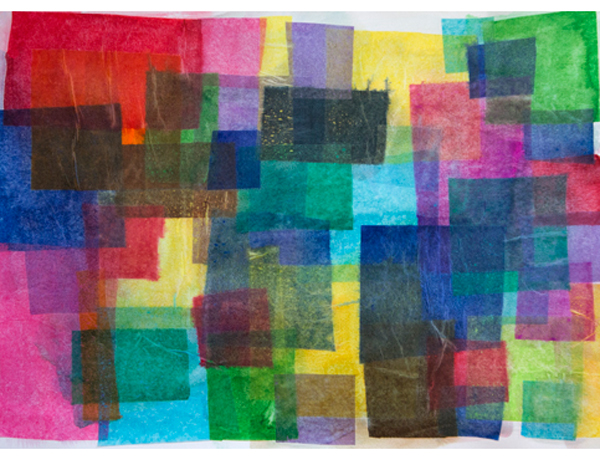
There’s nothing like a colorful collage of shapes that creates an eye-popping and exciting artwork. The other day when the tot awoke from her not-so-blissful non-nap time, instead of turning on the TV we attacked her play area trying to make sense of her random toys and such. While picking up all her wooden blocks it reminded me of an artist that used those simple shapes to create famous artworks of his own.
Auguste Herbin was buddies with Braque and Picasso, exploring all the excitement of Cubism and hard-edged shapes. While living in Paris, He hung with his friends while creating abstract and colorful artworks that turned those simple shapes into something really special. With his use of pattern, rhythm, and balance, Herbin combined his exploration of Impressionism and Fauvism into his form-filled paintings.
After putting those blocks on our work table, I cozied up with the tot to take a closer look at Herbin’s paintings. Even though my daughter’s only two, she throughly enjoyed looking at the paintings and calling out the shapes she recognized. Older kids can check out Herbin’s use of pattern and repeating shapes and colors to create his balanced paintings.
Now get out a sheet of white paper along with a piece of scrap paper to put some blobs of paint. Your child can use the primary colors (red, yellow, and blue) along with black and then explore color theory by mixing to create other colors – such as orange, purple, or green.
Invite your child to tap the wood blocks in the paint and then arrange on the paper, using a favorite Auguste Herbin painting as inspiration. Don’t have any wood blocks? Your child can cut shapes out of cardboard or use the tops or bottoms of bottle caps, yogurt cups, or tupperware containers.
Encourage your child to continue tapping and pressing the shapes until the whole paper is covered along with thinking about composition and balance. She can create a few patterns or areas of repeated color to move the viewer’s eye around the artwork.
Now your child can think about overlapping colors and shapes, just like Herbin did. Sure, she can go crazy and overlap lots and lots, or just select a few shapes to highlight with an overlapping shape.
Once the artwork is dry, your child can display her finished Auguste Herbin artwork in a spot that needs a bit of color and excitement!