Tag: child development’
What to do when your toddler colors on everything and anything
- by Sarah Lipoff
Remember last week when I shared that post about right-brained dominant (a.k.a super creative) kids? While writing it, my toddler was enjoying her not-really nap-time. She doesn’t really sleep anymore, she just has quiet time in her room. I’ve got it stocked with her favorite books, stuffed animals, a chalk board with chalk, and most recently, crayons and a few coloring books. She’s really into creating tons and tons of creations to mail to Gamma and Opa, so I figured I could trust her to keep those crayons on the paper.
Because, you remember when she colored on the wall, right?
(which resulted in the homemade chalk board…)
The thing is, your toddler is hard-wired to make marks. Her right-brain is in overload, desperately searching for ways to share thoughts, feelings, and ideas. This stage of creation is referred to as the scribble stage, due to the child’s desire to scribble, scribble, scribble. Nothing looks like much, but your toddler can actively tell you about the animals, monsters, people, and other crazy stuff in artworks. Before you discard those pages and pages of scribbles, understand it is the expression of your child’s brain developing in amazing ways. From starting to understand hand-eye coordination to simple mathematical concepts, your toddler’s scribbles are the stepping stone to speech, reading, and writing development.
Meaning, it’s a good idea to encourage your child’s disorganized scribbling as much as possible.
But what to do when your child colors on everything and anything possible?
Remember the afore-mentioned day – that day I was writing and the tot was “napping?” When I went down to see if she had actually fallen asleep, because things had gotten pretty quiet, I made quite the discovery. She had colored everywhere. From her dresser to her closet doors to her side table to her light switch, just about everything in her room had a colorful mark.
Before I took a moment to think I scolded her. Instantly I realized it was the absolute wrong decision. She had spent just over an hour artfully decorating her room in a way she was excited about and excited to share with me. She had spent time expressing herself though scribbles and colors (really, each area was a different color combination), and she was looking forward to dazzling me with its beauty. And, I had left those crayons in her room. After we both calmed down, the two of us spent some quality time together cleaning up those scribbles and discussing where those crayons belong – on paper!
Do you have a super scribbler? Here are a few simple ways to encourage those marks to stay where you want them:
- Don’t leave any mark making implements within reach of your child (unless you are right there!): Yes, this is a bit of a no-brainer, but, as your toddler ages, you begin to feel they have an understanding of keeping crayons on the paper. Remember your toddler is still a toddler (until the age of four) and still has those inner-toddler instincts to see what might happen. Leaving crayons out for your child is an open invitation to color away on whatever is available. Make time to color alongside your toddler showing your amazing skills to keep those crayon scribbles on your own paper. Toddlers love copying behavior.
- Designate a coloring area: Make a spot in your home just for your toddler to create. Whether it’s the kitchen table, a small end table no one uses or an easel in the corner, make sure your toddler knows this is “the spot” to go for making marks. Keep the area stocked with paper, stickers, and chalk (which washes off everything) but keep the markers and crayons out of reach. When your child finds herself over at her creative spot, offer crayons, markers, or paints – but keep an eye on things. As your child matures, she’ll understand the area is for being creative, and markers shouldn’t travel around the house.
- Don’t be afraid: Sure, you might not be into fingerprinting, but your child is. Art is one of the main ways a child defines who they are. Getting creative with your child shows that you find her scribbles important, encouraging her self-esteem. You’re going to get messy. Your child is going to get messy. Stuff in your house might get messy. But, if you have a plan of attack, and stay calm, things will turn out wonderfully. Use plastic placements under paper to cut back on mess. Or, place a sheet pan under artwork while painting. Keep a wet washcloth (or a container of baby wipes) next to your creative area to tackle messes the minute they happen.
- Don’t yell (but don’t praise either): At some point your child is probably going to color on something. Hopefully, it will be with a mark-making implement that is washable. Before reacting, take a deep breath. If you are expecting it to happen during the toddler years it won’t be such a big surprise when you come across a colored white wall, right? Start by acknowledging what you see and then calmly explaining that crayons only belong on paper. Walk your child over to your creative area and get out a paper for your child to scribble on. Once she’s had a moment to make a few marks, remove the crayons. Walk back to your newly colored wall and discuss how the walls aren’t for coloring, but for hanging pictures and that you can frame one of her artworks to look at….
- Frame your child’s scribbles and hang them on the wall: Even though you might not think her scribbles are anything exciting, she sure does. If your child spends a good amount of time on a creation, pick up a simple frame (less than $10 at the craft store!), pop in her artwork, and display in your home. Make sure to point it out to your toddler or hang it at just above arms reach so she can stand in front of her framed artwork and appreciate it. Not only are you showing you are proud of her and her abilities, you are encouraging her to continue exploring her creativity.
So get out the crayons and start scribbling – on paper!
Oh my gosh your kid is so creative! (Right-brain dominant kids)
- by Sarah Lipoff
My tot is only three and she’s in love with coloring, coloring, painting, coloring, cooking, imaginary play, and more painting. I often hear the, “Oh my gosh, she’s just like you” comment, along with the, “You’re so lucky she is so creative!” Well, am I? The thing is, I’m hyper-creative. While writing this I’m also thinking about what I’m going to cook for dinner, that the downstairs hallway needs painting, how I’d like to do a finger paint canvas project with the tot, and how cool it would be to make a soap dish from a cabbage leaf pressed in clay.
I’m a bit ADHD right-brain creative.
Along with having all these awesome ideas running through my head, I’ve got life to contend with. Often my ideas are a flash and then gone.
I also can’t add without using my fingers.
(really)
Creative kids often struggle with logical real world stuff. The right-brain is hardwired to indulge creative thought, pushing that mathematical, sensible, and reasonable left-brain to the background. Encouraging creativity is important for all – but sometimes it is important to make sure those that are creative are getting a bit of that logical left to balance things out.
The Right-Brain Dominant Child
A child’s brain is an amazing thing with areas in charge of logical thought, which may not be used as often as parents (and teachers) would like, and also creativity. The brain is divided into two hemispheres – the right and the left. The left side of the brain is dominant over the right side of the body and the right over the left. This means left-handed individuals are thought to be right-brain dominant, but it is not always the case. Before labeling a child as a right-brain learner, remember that the entire brain works together to create a complete human being, but many do have tendencies toward a specific half.
Right-Brain Characteristics
When a child seems to excel in the creative arts, is excited about doing hands-on activities, and exploring and experimenting, the right side of the brain is probably dominant over the left. Several developmental characteristics are often associated with right-brain learners such as higher levels of creativity and language skills. Along with these positive attributes, right-brain dominant kids are often thought unorganized and easily distracted.
A right-brain dominant child may also be classified as a visual- spatial learner, which means the brain taps into learning through visual clues, the child prefers information given all at once, and learns through doing not observing. Those long mathematical problems or activities that follow multi-step directions may cause a right-brained child to tune out. In a perfect world, children would be taught in ways most appropriate for their learning style, but with a majority of the population leaning toward being left-brain dominant, a more structured, linear, and goal-oriented way of education prevails. This causes many a teacher to feel a child isn’t able to perform as well as other children without realizing that it may have more to do with how the information is presented.
Learning with a Right-Brained Child
Now that you have determined you have a right-brained child, what is the next step? There are simple ways to encourage your child to tap into both sides of the brain, which not only allows the dominant side to shine, but balances the whole being.
- Use your child’s creativity to help utilize left-brain strengths. Most right-brain dominant children enjoy learning through doing. Turn the next challenging math assignment into a creative experience by encouraging brain to think in different ways. Spend time talking through the assignment with your child, or even act out ideas, and encourage taking notes to help remember details later. Not only does this help keep things on track, but encourages the linear left-brain to work alongside the creative right.
- When your child is ready to get working, encourage solo work time. Often right-brained children enjoy working with others, which may lead to wonderful and exciting learning opportunities within the classroom, but can take a child off-task when completing homework. Tap into the left-brain by giving your child quiet space to focus on the task at hand. When a task is completed, celebrate with an engrossing and engaging game or activity that rewards all that hard work.
- Use your child’s visual brain to its best by encouraging learning through using color. When studying for an upcoming spelling test offer your child a pre-test and then focus on the words that were challenging. The HSLDA (Home Schooling Legal Defense Association) suggest writing out the misspelled words on cards with the letters that are incorrect in a different color. For instance, if your child writes Saturday as “Saterday” write the correct letters in black and the incorrect “e” as a “u” but in red. Help your child make the flash cards together to encourage the left and right brain to work together.
- Take your time – and encourage your child to do the same. Visual-spatial learners do not work well under pressure. Although, in most cases, school tests are timed, while at home, offer your child as much time as needed to get work done. If your child is challenged with an activity, encourage drawing a picture or creating charts to show visualization the activity. Offer assistance and encouragement without judgment or getting frustrated if things are taking a bit longer than desired.
- When in the classroom, offer the right-brain dominant child lots of opportunities for visual learning, which means including charts in lectures and visuals when discussing an assignment, such as pictures of birds when learning about migration. All children enjoy looking at visuals when learning, so including additional images as often as possible only aides in everyone’s education.
Having a right-brained dominant child may seem like a roller coaster at times, with moments of total excitement and crashes with great disappointments. Working with your child is key, no matter the learning style, which encourages positive learning for years to come.
Fine art for kids: Color field with Barnett Newman
- by Sarah Lipoff
The other day the tot and I got out the paints and spent some time swirling and moving our brushes all around our papers. My daughter was pretty insistent on using one color for covering the entire area. While watching her concentrate, I couldn’t help thinking of the color field modern paintings by Barnett Newman. Newman’s famous creations, which he called, “zips,” filled canvases with colors strikingly divided by a thin straight line. He was considered an abstract expressionist and one of the big players in the American color field movement during the late 1950′s.
While the tot was busily painting away, I pulled up a few of Barnet Newman’s paintings and shared them with her. She yelled out colors and pointed while I scrolled through the images. This is an ideal project for toddlers, perfect for honing fine motor skills through holding and painting with a small brush and encouraging tots to think of the whole picture – or using the entire paper for creating.
Get out a plastic place mat or a few sheets of newspaper, a sheet of white paper, a length of painter’s tape, several small paintbrushes, a small container, and tempera paint. Get your child set up with the place mat – or newspapers – and then place the paper in front of her.
Offer your child a length of painter’s tape that is just a bit longer than the width of the paper. She can pick the perfect spot for pressing it onto her paper and the place mat underneath.
Now your child can select which color she’d like to use for her Newman inspired color field painting. My tot yelled out, “RED” and red it was. I squeezed a bit into a small container and got her set up with a few different sized paintbrushes.
Encourage your child to swirl and move her paintbrush all around the paper, covering the entire area. This takes a bit of concentration – and motivation, so sit on down and keep your tot focused on creating a solid paper full of color. Kids at this age love to scribble away, which is exactly what this abstract art activity is all about, except with paint!
Once the entire paper is covered, let things dry before inviting your child to carefully peel of the tape. Now your child can make another exciting abstract color field creation using two pieces of tape – or three – and as many colors as she’d like. Display the finished creations together showcasing the big areas of color.
Fun and exciting left-brain art activities (that trick the right brain into participating)
- by Sarah Lipoff
Left-brain art activities don’t have to be boring – they can be filled with exciting ways for enticing kids to tap into the benefits of combining both sides of the brain into one fun creative machine. Kids often let the dominant left-brain take charge forgetting the beneficial creative right-brain completely, leading to comments such as, “I can’t draw.” Encouraging creative left-brain art activities promotes self-confidence and the child’s brain to work together when getting creative and problem solving.
Toddlers
Young kids greatly benefit from activities that engage the left-brain in creative art projects. Introduce kids to shapes along with the math concept of pattern through a fun water resist art activity.
-Look at patterns with the child and discuss how they are created. The left-brain is encouraged when the big picture is looked at instead of the small parts of a project.
-Offer your child a sheet of white drawing paper and a set of crayons. Younger children can enjoy the process of engaging the logical left-brain through creating simple shapes, while older toddlers can attempt to create patterns using both colors and shapes. Or, if you’ve got a real young one, help them out by creating a few shapes together.
-Remove the crayons once he’s finished making patterns. Your child can now paint all over the paper using watercolors, practicing dipping his paintbrush into the paints on his own, which develops fine-motor skills. Invite him to paint without concern for staying within lines or following any set directions, allowing his creative right-brain to coordinate with his left.
-Discuss the finished artwork together further engaging the child’s visual cortex and his creative development. Talk about what he liked about the art making process and encourage him to explain his finished patterns.
Children Aged 5 to 7
As kids age and become more critical of their artwork, encouraging left-brain art reminds them that artwork doesn’t have to solely rely on creativity but can be accomplished through using left-brain skills, too. Create a geometric design with your child, which encourages basic math knowledge as well as artistic skills.
-Discuss geometric shapes with your child, having him draw pictures of as many as he can and then write the names of the shapes, further engaging his left-brain.
-Invite the child to select three shapes to use for his geometric design.
-Give the child a sheet of white drawing paper and have him draw the first shape he selected with a marker so that it almost touches the sides of the paper. Offer him the use of a ruler to help create his lines. Then he can draw the second shape within the first, and the third within the second shape, making his three shapes all within each other.
-The child can now use markers to color each shape in, using a different color for each shape.
-Discuss how the finished creation is an abstract masterpiece, full of shape, line, and color.
Children Aged 8 to 13
Older children begin to lose interest in art as they age, which is also partly due to art classes not always a part of many middle schools and high schools as a required subject. Preteens are at risk of missing out on honing creative skills and finding ways to remind the brain that merging right and left-brain talents helps form a complete human being. Challenge kids by creating a 3D sculpture from a piece of construction paper.
-Provide the child with an 8 by 10-inch piece of construction paper and invite him to figure out a way to create a freestanding 3-dimensional form using solely the paper and a pair of scissors.
-Look at modern sculptures by the American artist David Smith, and discuss how he came up with the motivation to make the interesting forms. Discussing artwork stimulates the visual cortex and promotes use of the right brain.
-Brainstorm ideas for how your child can create the sculpture. Working through the problem to find a solution kick starts the left-brain, making it ready for the challenge.
-Encourage the child to fold, cut, and shape the flat paper into a form that is able to stand on its own without support.
-Once finished, display the folded and cut marvel in a location for the whole family to enjoy.
Young Adults
Once kids hit young adulthood, they become aware of their inabilities in the area of the arts. Most feel they aren’t creative, where in reality creativity is hiding out in the right-brain just itching to get out. By creating a mathematical grid drawing, your child is able to easily and comfortably recreate an image without fear of mistake or disappointment – and pulling out that hidden creativity.
-Chuck Close is an American artist that uses mathematical grids to recreate photographs into larger than life portraits using pointillism. Look at examples of his work with your teenager and discuss his techniques.
-Invite your child to find an image from a magazine or an actual photograph to recreate in the style of Chuck Close.
-Using a ruler and some basic math, he can figure out how to enlarge the small image onto a larger piece of paper. For instance, if the photograph selected is 4 by 6-inches, he can create a grid with marker lines every 2-inches around the image. The small 4 by 6-inch image can be enlarged onto a 12 by 18-inch piece of paper with a grid drawn lightly in pencil every 6-inches around the paper.
-Your child can use markers to recreate the image using large and small dots of color, encouraging the left-brain to work methodically from one square to the next in the grid formation.
-Due to the left-brain not feeling challenged to create a realistic image, the right brain is able to offer a helping hand, which allows your teenager’s artistic abilities to shine through without him even realizing it.
-Display the finished grid drawing alongside the picture, sharing with others how the artwork was created.
By encouraging kids to use their left-brain and their inner creativity, they will feel confident about their artwork and also feel ready to share their creativity with others.
Oh, the toddler years (and Piaget)
- by Sarah Lipoff
There are days that being a parent is really hard. Hey, there are lots and lots and lots of days when parenting is challenging. As an educator (before having kids), I had a very different style of behavior management than I do as a parent. I’ve also had the opportunity to learn about and test out different educational concepts, styles, and philosophies. And I’ve realized that it goes out the window when I’m desperately trying to leave the house and the tot is frustrated because I won’t let her wear what she wants (no matter the weather).
Yeah.
But, I often do reflect on those educational concepts and philosophies to remind myself of those amazing people who explored and exposed others to the wonders and specialness of the developing mind, reminding us all that even in those tough moments, things will get better. And, Jean Piaget was one of those guys.
The early years of life are full of colors, sounds, experiences and experiments. Children learn through their senses along with interactions with others, which are sometimes good and sometimes not so great. Jean Piaget, a Swiss born biologist and psychologist, felt that every interaction establishes cognitive structure in children. Sure makes you think twice about using that cookie as a bribe for some good behavior, right? (which I totally did during potty training…)
So, here we go…
Piaget and the Child Developmental Model
Piaget came to his conclusions after spending time observing children while they were learning and playing. His research in the 1920’s was groundbreaking in the understanding of the workings of young minds. His ideas offered insight to adults as to the developmental stages of children creating opportunities to enhance learning in the classroom and adult interactions with children. His renowned child developmental model is based on the idea that the developing child builds structures or maps in response to understanding physical and cognitive experiences within her environment, which include:
Sensorimotor stage: (from birth to 2 years of age) During this stage the child is internally motivated to interact physically with her environment, building an understanding of reality and how it works. A child at this age is not aware of object permanence yet, which means she has not figured out when something is out of sight, it is still in existence.
Preoperational stage: (2 to 7 years of age) The child is yet to understand abstract reasoning and thinking and still needs concrete physical situations. This means using bribes to achieve desired behaviors may have negative consequences later in development, as the child does not understand the reasoning behind the process – just the result. And, like I stated above, I used bribery during potty training. Oops.
Concrete operational stage: (7 to 11 years of age) By this time the child has gained important knowledge through physical interactions with her environment and is starting to conceptualize and create logical structures from her experiences. The child is able to understand abstract reasoning and is ready for advanced learning concepts such as arithmetic.
Formal operational stage: (11 years of age and beyond) The child is now able to fully function as an adult as far as conceptual reasoning and understanding. She is ready for challenges and new experiences that will encourage her brain and understanding of the world around her.
Encouraging the Piaget Model
Through these stages, there are several ways adults can positively influence learning through Piaget’s concepts. Either within the classroom or in the home, the child greatly benefits from added support and encouragement. By taking a look at each stage of learning and actions that the child begins to master, the adult can find ways to offer positive reinforcement.
Sensorimotor – During this stage, the child is limited by her abilities. Basic characteristics include grasping, reaching, and reflexive behaviors. Adults can motivate a baby of this age to grasp by putting small toys outside of her reach or hanging a mobile over her crib. Reading with the child encourages language through listening to inflections and watching movements of the face. As a baby ages playing simple games such as “peek-a-boo” or hiding an object just outside a child’s reach encourages the understanding of object permanence and cognitive development.
Preocupational – Speech is one of the main advancements during this stage, with language taking up a large part of development. Along with figuring out the world through experimenting and asking lots and lots of questions, the child is also working out moral dilemmas and becoming less egocentric. This means that wonderful lack of object permanence will soon be gone, causing the child to become attached to a special blanket, toy, or parent – which can lead to extreme melt-downs. No joke.
This is a great time to play board games with simple rules or offer experiences for the child with basic steps. Taking turns and following directions is challenging at this age, but the more experience the child has leads to greater cognitive development.
Concrete operational – A child is ready for challenges at this stage. This means her cognitive development is motivated for advanced tasks that encourage multiple ways of thought, multi-tasking, and logical sequencing. Other models are essential to her cognitive development, with teachers, friends, and other adults encouraging her learning and evolution. Offering opportunities for advanced learning through educational or recreational activities is a way to hone skills and encourage individuality. If a child is excelling in the arts, encouraging classes in an area of interest is beneficial to her development and self-esteem.
Formal operational – Abstract thought has fully developed and the child is now ready to take on adult concepts and is able to demonstrate knowledge through proper use of symbols and abstract concepts. This does not mean the child is a fully functioning adult, but that her brain is honed to take on greater tasks and learning. This is a time for conversation and debate along with doing. The child’s thinking is less focused on concrete reality and is able to take on conceptual thoughts. Spending time talking through foreign concepts and problems encourages development and build cognitive growth.
Piaget’s model is one that offers insight and understanding of child development, which benefits teachers and parents alike. Encouraging kids during these stages provides much needed support and nurturing, and offers some wonderful opportunities for healthy bonding.
Simply circles
- by Sarah Lipoff
This week went by in a blur. The tot started going (one day a week) to a preschool all on her own – and she’s in love. I spent the first half of the week freaking out over actually leaving her (for the first time ever) with someone other than her Opa and Gamma. Yes, we’ve managed to get this far without babysitters, and, admittedly, are going a bit bonkers. So, when her first day went so successfully, the husband and I started breathing a bit easier – and realized it was time for our tot to spread her wings and fly a bit more (and now I have the song in my head – super cheese, but go listen if you want).
Fridays are the tot and I’s day off. We lounge about, head outdoors, do a few art activities, and try new recipes. This morning we kept things simple and focused on learning more about color and shape recognition with circles. This is a great toddler activity that also encourages organizing (cleaning!) as well as language and math skills. I gave the tot the big assignment of searching through all her toys for things in the shape of circles while putting all other things away.
And, she did it.
While I watched in amazement, I got out a couple of sheets of paper and our red, yellow, and blue tempera paint. Once she had a collection of circular items, we went through them discussing if they had any sides while comparing them with other shaped objects. We determined that squares have four sides, triangles have three, and circles look just like the letter “O.” I also added a few circle items to her mix such as a sliced lemon and a wine cork.
Then she helped me squeeze a bit of the red, yellow, and blue paint onto a sheet of scrap paper. She wanted green, and I explained to her that red, yellow, and blue are super-special colors called the primary colors that mix together to create other colors. During this discussion she did a lot of blinking and reaching for the circular objects…
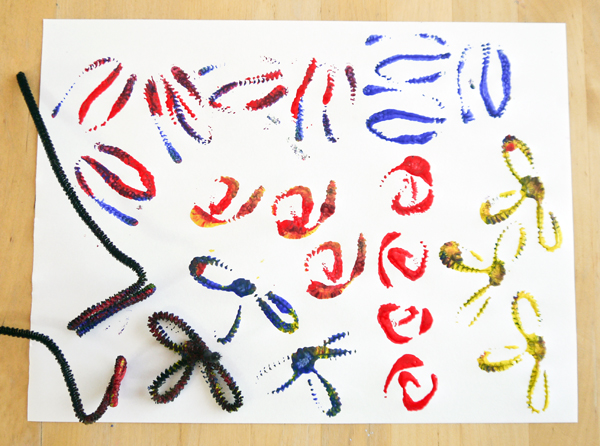
I let her loose to press the circle stuff into the paint and then stamp, stamp, stamp on her paper. If your tot gets frustrated with her paper moving all about while creating, tape the edges so things stay in place. Make sure to have lots of extra sheets of paper on hand to edit while creating. I often switch out papers once things start mixing together into a big brown mess.
And, low and behold, while I was finishing the tot’s “organizing” she yelled out, “geeeen!” Sure enough, that color-theory lecture payed off! Once the simply circles creations are dry, invite your tot to select her favorite and proudly display it on the fridge.
Don’t have lots of circle stuff around the house? Do the activity with squares, or triangles, or rectangles. Or, make things even more interesting by assigning each shape a color (for example: triangles go in the red paint) and see if your toddler can follow the colorful directions!
Fine art for kids: Sand painting with Robert Smithson
- by Sarah Lipoff
While on vacation (and staring at the beautiful ocean last week) I was reminded of a few really stellar outdoor installation artists and the amazing natural materials that can be used to get creative. The tot spent hours and hours finding sticks to use for drawing in the sand, and the last day of our vacation, really got into collecting rocks, checking them out, and then giving them a toss into the big collections rocks around the beach.
(which was okay because there was seriously no one else on the beach otherwise throwing rocks would have been a big no-no….)
Since we’ve been home, no one’s been really excited with our “real lives.” The beach was awesome, and who doesn’t love spending hours and hours on a desolated stretch of beach lounging about while chatting and reading and watching the tot do silly dances while loudly chanting the A,B,C’s? So the other afternoon during what should’ve been nap time (but had turned into toddler tantrum time) I got out the trusty laptop and scooped up the tot to check out a few examples of outdoor installation art by Robert Smithson.
Born in New Jersey, this American artist is not only an artist artist, but also a published author. From poems to prose to outdoor installations, Smithson was a busy guy. His famous work, Spiral Jetty, was completed in 1970, created with mud and salt crystals in Utah’s Great Salt Lake. This curving length of sometimes exposed man-made earth was one of Smithson’s final creations and took six days to complete. After the tot and I spent a few moments checking out the different images of the Spiral Jetty, I shuffled her over to the table to get started on our own Robert Smithson inspired creations.
Offer your child a sheet of white paper and a set of watercolor paints, a small container of water, and a big paintbrush. For the younger kiddies, this is a great opportunity for building color recognition skills. Invite your child to coat her paper with only blue watercolor paint. Older kids can concentrate on creating an area of blue that is representational of an ocean or large area of water, even adding details such as waves.
Once your child has finished painting, allow the paper to dry, which really doesn’t take very long. While you’re waiting you can gather what you need for creating the second part of the Smithson creation. Take a minute to discuss the outdoors and how natural objects can be turned into art – even mud! This encourages kids to think of the earth as art, developing earth science and environmental concepts
The Spiral Jetty was created using mud and salt crystals, which might get kind of messy. So, instead, gather together some glitter (I used silver and red), salt, and sand (like the stuff in the sandbox). You’ll need about 1 tablespoon of each. Have your child measure and then add the sand painting ingredients in a small bowl, which also enhances and encourages math skills.
Invite your child to get out glue and a small container. She can squeeze out a good dollop of glue and then thin with a bit of water.
Now get out that blue paper back, place a couple of sheets of newspaper underneath, and encourage your child to dip her big brush in that glue water and paint a big spiral on her paper, just like Robert Smithson’s Spiral Jetty. Invite her to sprinkle the sand mixture all over the glue water, totally honing her fine-motor skills.
Leave the creation flat on the table for an hour or so and then your child can carefully lift up her paper (which can get a bit messy – hence the newspaper to catch all that leftover sand) and reveal her Robert Smithson artwork.
Pour the remaining sand into a container for the next time your child feels like creating another sand painting and find the perfect spot for showcasing your child’s finished artwork.
Constructivism and your child
- by Sarah Lipoff
Now that the tot is three, so many things have changed. She can talk her way through temper-tantrums explaining to us specifically why she is screaming and ranting, run that much faster away from us while we yell her name (desperately), and determine for herself if she’d like to nap or not (which is not so great for any down time for me). Sure, she’s also developing in amazing ways and exploring all the new things her brain and body can do, but it really seems so many of those things turn into a reason to have a toddler/parent show down.
And, during those moments, I try to take a few deep breaths and remind myself she’s a toddler and her behavior is typical. She’s also learning from the world around her, so setting a positive example is essential. It’s also pretty important to take a step back as the parent and give the child a chance to explore and learn from mistakes.
Through the concept of constructivism, a child is encouraged to learn through determining his own path of knowledge and individual process. Each child is different and special, just like their learning, and constructivism supports the idea that we construct our own understanding of the world we live in through generating rules and ideas based on individual experiences and trail and error. With the learning theory of constructivism, there are no flash cards or standardized tests. Instead, the child is supported to follow her instinct and create her own knowledge and strategies for understanding and learning.
Um, what the heck is constructivism? Don’t worry, it’s nothing to freak out about – and you might find learning about constructivism benefits you and your child. So, here are some facts…
The history of social constructivism leads us back to Lev Vygotsky and his social theories of learning. His studies found that a child often successfully accomplished new tasks while working in collaboration with an adult instead of on his own. This does not mean the adult is teaching the child how to solve problems, but through the act of the adult engaging with the child the learning experience improves and offers the child the ability to refine thinking and perform effectively. It is the idea of “can do” versus “cannot do,” and offering the child opportunities to change to the “can do” attitude with supportive, individual adult input.
By combining the idea of social and cognitive constructivism, the child is able to develop in positive ways. Social constructivism emphasizes the learning a child accomplishes through interaction with others and outside experiences. Cognitive constructivism is based on a child’s developmental stages and individual learning style. As stated before, each child is different and when her specific learning style is determined, her ability to learn is enhanced, especially when adults are able to fine-tune teaching to fit her specific learning.
Teaching with Constructivism
The educational system is not conducive to comfortably support constructivism in the mainstream classroom. But, there are small things educators, and parents, can do to support a child’s learning and development through constructivist theory. It is thought that most educators view learning as an objectivist theory, with the belief that learning exists outside of the bodies of learners residing in books and other educational documents. This leads to curriculum being based on teaching the child through textbooks instead of through experience. Through constructivism, the main way of learning is the senses, causing the brain to build a full understanding of the surrounding world. This leads us back to the understanding that each child is an individual creating separate unique responses and experiences.
With testing being the popular way to determine a child’s knowledge base, constructivism encourages the concept of experience and interaction. The process of learning through doing and engaging is the goal. Also, understanding each individual child’s prior-knowledge is key, used to build and grow adult interactions and teachings. This encourages greater bonds between adult and child and deeper educational experiences resulting in higher knowledge and self-esteem.
Ways to Integrate Constructivism
Introducing constructivist theory may seem like an unattainable goal for the classroom, but educators can make a difference through making simple changes and a bit of extra time. Parents can benefit from doing the same thing, creating a positive environment where the child is encouraged to explore and build his knowledge base through constructive ideals.
Take time to talk: It’s challenging in a bustling classroom to cover topics required by state standards of learning and maintain requirements of the school, but shortening lectures and book study and adding more interaction and discussion is one way to offer each student the opportunity to take part in learning. Including activities that encourage the student to apply their existing knowledge and real-world experiences promotes constructive learning. A healthy class debate is always a wonderful way to talk things out and hypothesis new ideas and problem solving.
At home, take time to talk through problems and encourage conversations at the dinner table, discussing new and exciting topics. And, don’t forget to ask lots of open-ended questions!
Doing is learning: Get out of the classroom and use those senses for learning! This goes for the home environment, too. As a population, we get caught up with the Internet and other social media as ways of entertainment and education. That big, heavy textbook has been replaced with surfing the interwebs. Turn to the great outdoors, along with real-life social interactions for learning and growth. Taking students into the real world to test their ideas and knowledge benefits constructive learning and understanding. Encourage a group discussion to finish the lesson after the out-of-classroom experience. And, parents can do the same by getting out of the house for a simple nature walk.
Ditch your expectations: Constructivism is not about test results and rote learning but about developing the child’s senses and understanding of the world around her. Find ways to encourage that learning through doing activities that are free of set limits and end results. Allowing a child to experiment with open-ended activities encourages creativity and self-esteem. If talking about weather systems, have students create a colorful weather collage. When discussing architecture, brainstorm as a group ways for building better covered bridges. Not only is the child developing her brain in amazing ways, she is pushing her senses to the limits learning more about his strengths and weaknesses and then making adjustments. Offering pre-tests allows for the teacher to gain understanding of student’s existing knowledge, aiding in creating educational lesson plans.
At home, direct open-ended questions without pressure on expectations. Use language focused on learning instead of results, such as grades, to instill confidence.
Introducing constructivist theory into the home or classroom is easier than one might think and offers fantastic benefits for both child and adult. So get out there and do some open-ended activities!
Fine art for kids: Layering with de Kooning
- by Sarah Lipoff
The other day the tot was really into running her cars on everything. She raced them up and down the stairs, along the walls, and even through some paint. While I was hoping this fascination would wane, I actually was inspired by her artistic creation, which reminded me of an artist I know and love. Willem de Kooning was a Dutch born artist that lived in New York for the majority of his life creating colorful and vibrantly strong images. His technique of layering on colors sometimes with strong black lines that form a figure intrigue viewers into take a closer look.
Along with being full of color, de Kooning’s abstract creations are almost childlike in the way they are sloshed together. There are chaotic areas of color, jumbled together lines, and, somehow, an image all together in one place. I pulled the tot up to the laptop and shared with her a few of de Kooning’s creations to see what she had to say.
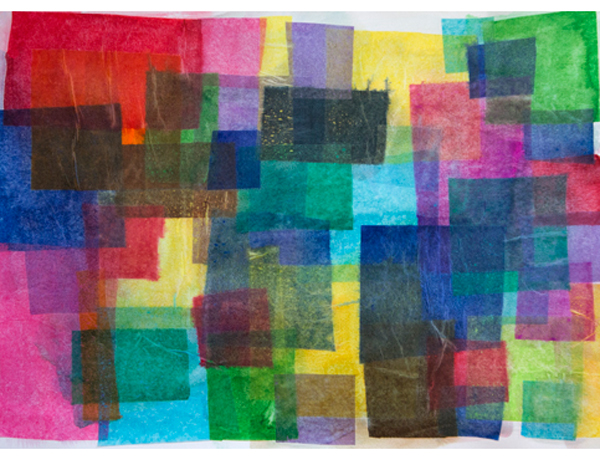
Because de Kooning’s artworks are a bit of a mish-mash of color and line, they are wonderful inspiration for some fun fine art creations. Invite your child to scrounge around for different types of art making tools (like feathers, big paintbrushes, tiny cars, plastic shapes), which can all be used to create expressive lines.
Along with being an exciting (and messy) activity, your child will learn more about color mixing and layering paint. Younger kids can simply mix paint along with experimenting with painting tools while older kids can try to create a form or shape hidden within the splotches of color.
Offer your child a sheet of paper and position all the painting items within close reach. If you’re not excited about mess, cover the area with newspaper and your child (and yourself) with a smock.
Go ahead and squeeze out a few drops of paint onto the paper and let your child have a fabulous time moving the different painting tools through the paint. Add more paint as you go, or swap out papers with fresh ones.
Once your child is finished, allow the artworks to dry for a couple of hours and then revisit. De Kooning often finished his artworks with the image of a person or additional areas of white to define the painting. Older children can use some black paint to bodily add more lines while younger tots can slather on a bit of white paint for extra impact. We dabbed on a bit of white paint and then ran the car over the painting a few final times with some dark brown paint.
Display your child’s finished de Kooning inspired creation in a special spot for others to enjoy!
Egg carton color fun
- by Sarah Lipoff
The rains have arrived here in Northern California, which means re-discovering old toys and finding fun things to do. I’m always looking for new ways to re-use stuff, and the corner of the room where the tots toys are looks like a big blow up of itty-bitty parts of puzzles and games (which no one is putting away).
We need some organization.
I pulled out a couple of egg cartons and knew they could be transformed into something useful and entertaining – at least for the day. With the help of some tape, tempera paint, and the creativity of the tot, we turned an egg carton into hours of color organizational excitement.
This is a perfect project for introducing color recognition to your kiddies – or for the older set, color theory. I offered some assistance helping to mix the primary colors (red, yellow, and blue) so the tot could paint green, orange, and purple cups, but older kids can be on their own to experiment and explore creating their own unique colors for painting the inside of the egg cups.
Simply cut the side off the egg carton, leaving the side with the egg cups, and use masking tape to section off the cups to encourage the kids to remember to paint each individual cup – instead of creating a big ol’ mess of color – and then let things dry.
While the paint is drying, invite your child to look through her collections of things for small items that are similar in color to the egg cups (which might also include a bit of cleaning up – yay!)
Once the paint is dry, offer your child the painted egg cups and invite her to organize her colorful items in the appropriate cups. She can see how many small toys she can fit in each cup, counting along the way, also encouraging her budding math skills.
Even if the egg carton color fun only lasts one day, it didn’t cost anything to make and was a fun and exciting way to organize (and maybe clean) your child’s toys – and encourage some color and math skills!